
What Should You Do With Your Well Water After Heavy Rain or Flooding?
When floodwater reaches a private well, the wellhead is damaged, or the water suddenly becomes cloudy, muddy, discolored, or unusual in taste or odor, do not assume the water is safe to drink. Use a confirmed safe water source, stay away from damaged electrical equipment, and contact your local health department or an appropriate well professional. The well may need to be inspected, disinfected, and tested before normal use resumes.
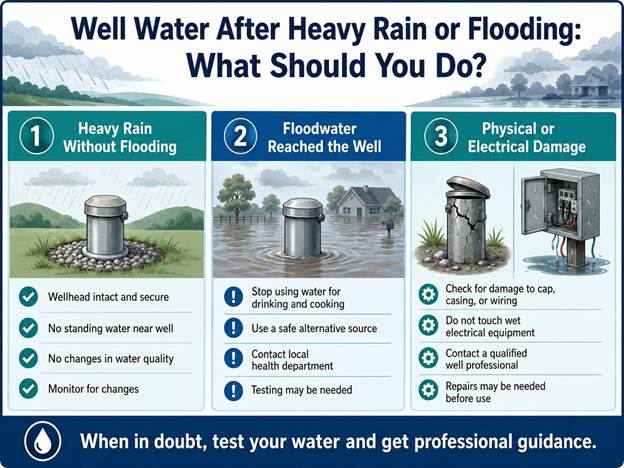
Heavy rain by itself does not prove that a private well has been contaminated. The level of concern depends on whether surface water reached the well, whether the well or pump was damaged, and whether anything about the water changed.
Does Heavy Rain Automatically Contaminate a Private Well?
No. Heavy rain does not automatically mean that a private well is contaminated.
A properly constructed and maintained well is designed to keep surface water out. Rainfall may not affect the water when the casing, cap, seals, and surrounding ground remain intact and floodwater never reaches the wellhead.
The risk becomes more serious when:
- Floodwater surrounds or covers the well
- Standing water remains near the casing
- The cap becomes loose, cracked, or displaced
- Soil erosion exposes or damages part of the well
- Debris strikes the casing or wellhead
- A nearby septic system floods or backs up
- Fuel, pesticides, sewage, or other chemicals may have entered the floodwater
- The water develops a new color, odor, taste, cloudiness, or visible sediment
These signs do not identify the exact contaminant. They indicate that the well structure and water quality deserve closer attention.
Homeowners who notice a storm-related change can review the company’s information about water color, taste, odor, staining, and other water problems. However, appearance and smell cannot replace proper testing.
What Should You Do Immediately If the Well Was Flooded?
Treat a well that was covered by floodwater or visibly damaged as potentially contaminated until it has been properly evaluated.
Use a Confirmed Safe Source for Drinking and Food Preparation
Do not use water from the affected well for:
- Drinking
- Cooking
- Brushing teeth
- Making ice
- Washing produce
- Preparing infant formula
- Giving water to pets when contamination is suspected
Use bottled water or another source that is confirmed to be safe.
Boiling is not a complete answer when chemical contamination may be present. Boiling may help address certain microorganisms, but it does not remove many chemicals. It may concentrate some dissolved substances as water evaporates.
When floodwater may contain fuel, pesticides, solvents, sewage, or industrial chemicals, follow guidance from the local health department rather than assuming boiling or a household filter makes the water safe.
Stay Away From Wet or Damaged Electrical Equipment
Flooding may affect more than water quality. Well pumps, wiring, control boxes, pressure equipment, and nearby electrical components may have been exposed to water.
Do not touch wet wiring or attempt to restart damaged equipment.
A qualified electrician or well professional may need to inspect the system before it is powered again. EPA guidance recommends evaluating the well and pump when flooding may have caused physical or electrical damage.
Contact the Appropriate Professionals
Different parts of the problem may require different professionals:
- Local health department: Public-health guidance, local testing information, and emergency recommendations
- Qualified well contractor: Inspection of the cap, casing, pump, seals, and physical condition
- Electrician: Evaluation of flooded wiring, controls, or pump equipment
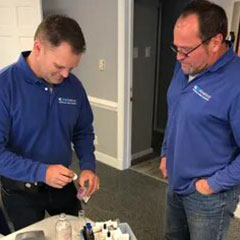
- Water-testing provider or laboratory: Correct sample collection and analysis
- Water-treatment professional: Evaluation of remaining water-quality concerns after testing
A water filter cannot repair a damaged casing, replace a displaced well cap, or stop surface water from entering the well.
How Can Flooding Affect Well Water?
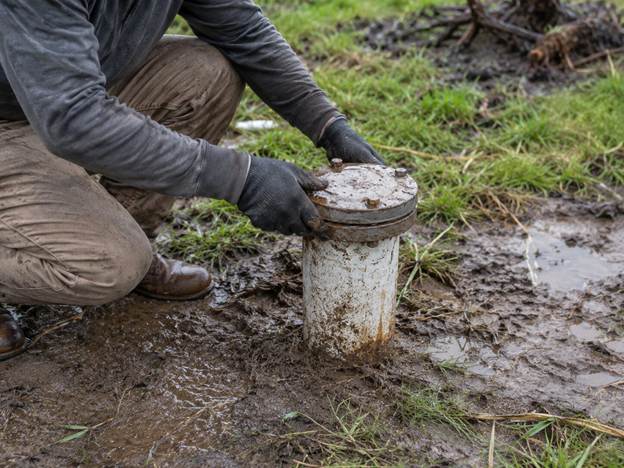
Floodwater can collect material from roads, yards, farms, septic systems, storage areas, and nearby properties before reaching a private well.
Bacteria and Other Microorganisms
Floodwater may carry microorganisms from sewage, soil, animal waste, and standing water.
Testing for total coliform and E. coli can help identify possible bacterial contamination. However, the meaning of a result depends on:
- How the sample was collected
- When it was collected
- Whether the well was recently disinfected
- Whether the structural source of contamination was corrected
- Whether the water remained exposed to floodwater
The company’s website lists presence-or-absence testing for total coliform and E. coli among its available testing services. Before relying on that testing for a post-flood decision, customers should confirm the collection procedure, laboratory process, turnaround time, and intended use of the results.
Sediment and Surface Debris
Flooding may introduce:
- Soil
- Silt
- Sand
- Organic debris
- Other suspended particles
The water may appear cloudy, muddy, brown, or unusually dark.
Clear water is not proof that contamination is absent. Some microorganisms and dissolved substances cannot be seen.
Fuel, Pesticides, and Other Chemicals
Properties near farms, garages, workshops, fuel tanks, businesses, or chemical-storage areas may face additional concerns after flooding.
A basic bacteria test does not identify every chemical. A standard sediment or carbon filter should not be assumed to treat:
- Fuel
- Pesticides
- Solvents
- Metals
- Industrial chemicals
- Unknown substances carried by floodwater
The correct testing panel depends on what may have entered the water and the conditions surrounding the property.
Damage to the Well Structure
Floodwater may expose or worsen problems involving:
- The well cap
- The casing
- Seals and connections
- Soil around the wellhead
- Pumps
- Pressure equipment
- Electrical controls
Disinfecting the water does not correct an opening that continues to allow surface water into the well. Structural problems should be addressed before permanent treatment equipment is considered.
Can You Tell Whether the Water Is Safe by Looking at It?
No. Water cannot be declared safe based on appearance, taste, or odor alone.
Water may look clear while containing bacteria or dissolved contaminants. Water may also look cloudy because of sediment, air, plumbing conditions, or disturbed treatment equipment.
A new taste, smell, color, or clarity problem is a reason to investigate, but the symptom does not reveal the cause.
Possible sources include:
- Surface-water intrusion
- Sediment entering the well
- A damaged cap or casing
- Plumbing corrosion
- Water-heater conditions
- Disturbed filter media
- Naturally occurring minerals
- Microbial or chemical contamination
For that reason, professional well-water testing is more useful than trying to select a treatment system based only on what the water looks or smells like.
Should a Flooded Well Be Disinfected Before It Is Tested?
The proper sequence depends on whether the well is damaged and which local or laboratory protocol applies.
Inspection, disinfection, flushing, sampling, and testing are related steps, but they are not interchangeable.
Inspect Possible Damage First
When the casing, cap, pump, or electrical equipment may have been damaged, inspection should come first.
Adding disinfectant to a damaged well:
- Does not repair the structural problem
- May not stop continuing contamination
- Can create safety concerns if handled incorrectly
- May affect the timing and interpretation of a water sample
The homeowner should not pour chemicals into a visibly damaged well without qualified guidance.
Follow the Correct Sampling Schedule
A water sample collected immediately after disinfection does not answer the same question as a properly timed clearance sample.
Ask the laboratory, local health department, or testing provider:
- When the sample should be collected
- Whether disinfectant must be fully flushed first
- Whether a waiting period is required
- Which faucet should be used
- Whether the faucet needs special preparation
- How quickly the sample must reach the laboratory
- Whether repeat sampling is recommended
Do not collect a bacteria sample in an ordinary household bottle. The correct sterile container and handling process matter.
What Should Well Water Be Tested for After Flooding?
There is no single post-flood test panel that is appropriate for every property.
The right testing depends on:
- What reached the well
- Nearby septic systems
- Agricultural activity
- Fuel or chemical storage
- Property use
- Visible well damage
- Changes in the water
- Local health-department guidance
Total Coliform and E. Coli
Total coliform and E. coli are commonly used as indicators of possible bacterial contamination.
A positive result may indicate that the water system has been exposed to environmental or fecal contamination. A negative result is useful, but it should be considered alongside the well’s condition, sampling method, and timing.
The website lists the following water-testing services:
- Presence-or-absence testing for total coliform and E. coli
- Nitrate, nitrite, and lead testing connected with FHA and VA needs
- Comprehensive utility-water analysis
- Testing for selected substances such as fluoride, lead, copper, nitrate, silica, and manganese
The company should confirm which of these tests are appropriate and available for a specific storm-related situation.
Additional Testing Based on the Property
Additional analysis may be appropriate when floodwater contacted or passed through:
- A septic area
- Fuel-storage areas
- Farms or fertilized land
- Pesticide-storage areas
- Workshops
- Commercial properties
- Industrial land
- Waste or debris
Possible testing may involve nitrates, metals, volatile organic compounds, pesticides, or another substance chosen for the suspected exposure.
A broad-sounding water test does not necessarily include every possible flood contaminant. The testing provider should explain what is and is not included.
What If the Water Is Still Cloudy, Muddy, or Smells Different?
A continuing change after the storm may indicate that the issue has not been fully resolved.
Possible causes include:
- Ongoing sediment intrusion
- Continuing surface-water entry
- A damaged cap or casing
- Changes in groundwater conditions
- Disturbed filtration media
- Plumbing problems
- Water-heater conditions
- Bacterial contamination
- Chemical contamination
Do not assume that one symptom leads to one treatment.
For example:
- A sulfur-like odor may begin in the well, plumbing, water heater, or treatment equipment
- Cloudiness may result from sediment, air, or another condition
- Orange staining may involve iron, but testing is needed to understand the water chemistry
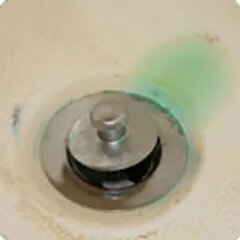
- Blue-green staining may involve corrosion rather than a filterable particle
Readers can learn more about common water problems and visible warning signs, but a professional evaluation is needed to determine what is happening at a specific property.
Does a Water Filter Make Flooded Well Water Safe?
Not automatically.
A water filter addresses only the conditions and substances it was designed to treat. Treatment performance depends on the equipment, configuration, maintenance, and specific contaminant.
For example:
- A sediment filter may capture particles
- A carbon filter may address certain tastes, odors, or chemicals
- A UV system may be designed for specific microbial-treatment applications
- Reverse osmosis may reduce certain dissolved substances
- A water softener addresses hardness minerals rather than every contaminant
None of these systems should be treated as a universal response to flooding.
A filter also cannot:
- Repair a cracked casing
- Replace a missing cap
- Correct damaged electrical equipment
- Prevent surface water from entering through a structural opening
- Identify an unknown contaminant
- Guarantee that the water is safe
Existing Treatment Equipment May Need Attention
A flood or power interruption may also affect equipment already installed in the home.
Possible concerns include:
- Loaded or contaminated cartridges
- Contaminated filter media
- Sediment accumulation
- Loss of pressure
- Electrical damage
- A bypassed system
- Contaminated plumbing downstream of the well
- Equipment that sat unused during an outage
The correct response depends on the equipment and the type of exposure. Homeowners should not automatically replace an entire system, but they also should not assume that existing equipment remained unaffected.
When Permanent Treatment May Be Appropriate
Permanent treatment may be considered after:
- The physical well problem has been corrected
- Necessary disinfection and flushing have been completed
- The water has been properly tested
- Results identify an ongoing water-quality concern
- The treatment has been matched to that concern
The company’s page about water-treatment systems in Virginia explains that residential and commercial solutions may include filtration, softening, acid neutralization, and reverse osmosis. The appropriate system should be based on the property’s water conditions rather than the storm alone.
When Can You Return to Normal Water Use?
There is no universal number of hours or days that applies to every flooded well.
Normal use may depend on completing several steps:
- Inspecting the well and pump
- Repairing physical or electrical damage
- Following appropriate flushing or disinfection instructions
- Collecting a correctly timed sample
- Receiving acceptable laboratory results
- Completing repeat testing when recommended
- Confirming that surface water is no longer entering the well
- Addressing remaining sediment, taste, odor, or treatment-equipment problems
Follow the instructions provided by the relevant health department, laboratory, well contractor, or other qualified professional.
How Can You Prepare Your Well for Future Storms?
Homeowners can make post-storm decisions easier by keeping basic information organized before severe weather arrives.
Consider the following:
- Know where the wellhead is located
- Keep the wellhead visible and accessible
- Watch for standing water or erosion
- Check the visible cap and casing for damage
- Keep fuel, pesticides, and chemicals away from the well
- Save recent test reports
- Record the well contractor’s contact information
- Keep local health-department information available
- Know which treatment equipment is installed
- Keep model numbers and service records
- Arrange an inspection when the wellhead or surrounding ground looks damaged
Do not alter the casing, seals, grading, pump, or electrical components without the appropriate professional experience.
Routine monitoring is also separate from storm-response testing. The company’s article about what annual well-water testing may include provides additional information for normal, ongoing well ownership.
Request Well-Water Testing in Central Virginia
A sudden change in well water after a storm should not be diagnosed by appearance alone. Testing can help identify whether the concern involves bacteria, sediment, minerals, or another water-quality issue.
Advanced Water Systems serves residential and commercial customers across Richmond and a broad Central and Southern Virginia service area. The website lists water testing, filtration, softening, acid neutralization, reverse osmosis, and other problem-specific treatment options.
Call (877) 609-2837 or contact Advanced Water Systems to discuss water testing.
For an actively flooded or damaged well, contact the local health department and the appropriate well or electrical professional first.
Frequently Asked Questions
Can I drink well water after heavy rain if it looks clear?
Clear water is not proof that the water is safe. When floodwater reached the well, the well was damaged, or the water changed after the storm, use a confirmed safe source and seek guidance about inspection and testing.
Should I boil well water after a flood?
Boiling may address certain microorganisms, but it does not remove many chemicals. When fuel, pesticides, sewage, or other chemical contamination may be involved, follow instructions from the local health department.
How soon should well water be tested after flooding?
The timing depends on whether the well needs inspection, repair, flushing, or disinfection first. Ask the laboratory or health department when the sample should be collected and whether repeat testing is recommended.
What if floodwater never covered the well?
Heavy rain alone does not prove contamination. Check for standing water, erosion, wellhead damage, septic problems, and changes in color, clarity, taste, or odor. Arrange testing when there is evidence the well may have been affected.
Will a whole-house filter remove flood contamination?
Not necessarily. Treatment performance depends on the exact contaminant and equipment. A whole-house filter cannot repair a damaged well and should not be assumed to remove bacteria, fuel, pesticides, or every other substance carried by floodwater.
Who should I call about a flooded well in Virginia?
Contact the local health department for public-health and testing guidance. A qualified well contractor may need to inspect the well, and an electrician may be needed when electrical components are flooded. A water-treatment professional can help evaluate ongoing water-quality concerns after immediate structural and safety issues are addressed.
External Sources
- U.S. Environmental Protection Agency: Post-flood guidance covering well and pump inspection, emergency disinfection, sampling, and testing. (US EPA)
- Virginia Department of Health: Guidance on private-well testing frequency and selecting tests based on possible contaminants. (Virginia Department of Health)
- Virginia Department of Health Private Well Program: Information about private-well ownership and the homeowner’s responsibility for ongoing testing. (Virginia Department of Health)
- Virginia Department of Health: Event-specific post-flood testing information following Hurricane Helene, used only to support the importance of disinfection, flushing, and sample timing. (Virginia Department of Health)