

Why Does My Well Water Smell Like Rotten Eggs?
A rotten-egg smell in well water is often associated with hydrogen sulfide gas or sulfur-related bacteria, but the odor can originate in the groundwater, well, plumbing, treatment equipment, or water heater. If both hot and cold water smell, the source may be farther upstream in the water system. If only the hot water smells, the water heater deserves closer attention.
The smell is an important clue, but it does not tell you exactly what is in the water or which treatment you need. Testing the water and identifying where the odor begins should come before choosing a sulfur filter or other equipment.
What Causes a Rotten-Egg Smell in Well Water?
Hydrogen sulfide, or H2S, is a gas known for its distinctive rotten-egg odor. It may be naturally present in groundwater, produced by sulfur-related bacteria, or generated through reactions inside a water heater. Pollution can also produce similar conditions, although public-health guidance describes that as a less common cause.
Advanced Water Systems also identifies hydrogen sulfide as a common possible source of rotten-egg odor on its page covering common water taste, odor, and staining problems.
Hydrogen Sulfide in the Groundwater
As groundwater moves through soil and rock, natural chemical and biological processes can produce hydrogen sulfide.
When the gas is coming directly from the well water, you may notice the odor in both hot and cold water and at multiple fixtures.
That pattern does not prove groundwater H2S is the cause, but it makes the well and incoming water supply important places to investigate.
Sulfur-Related Bacteria
Certain naturally occurring bacteria can use sulfur compounds and produce hydrogen sulfide as part of their activity. These bacteria may occur in:
- Groundwater
- The well
- Household plumbing
- Water-treatment equipment
- Water heaters
They can sometimes contribute to slime or buildup as well as odor.
The Water Heater
A sulfur smell does not always originate in the well.
Water heaters can create conditions where sulfur bacteria become active or where reactions involving the heater’s sacrificial anode rod contribute to hydrogen sulfide production.
If the smell occurs only when you run hot water, investigate the water heater before assuming you need a whole-home sulfur filtration system.
Advanced Water Systems has a page discussing powered anode rod options for hot-water odor when the standard water-heater anode is determined to be the source.
Is Rotten-Egg-Smelling Well Water Dangerous?
The smell alone cannot tell you whether the water is safe or unsafe.
Hydrogen sulfide and sulfur bacteria are commonly associated with nuisance problems involving taste and odor. However, an unexplained change in a private well should still be evaluated because smell cannot rule out bacteria or other contaminants.
Virginia Department of Health guidance recommends additional testing when a private well has an unexplained change in water quality, taste, or appearance. VDH also recommends routine testing for bacteria and nitrate in private wells.
This is why a rotten-egg smell should not be treated as proof that the only issue is sulfur.
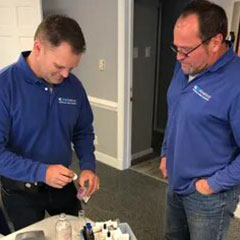
If the odor appears suddenly, becomes significantly stronger, or occurs alongside changes such as cloudiness, sediment, unusual color, or another unexpected water-quality change, professional well-water testing can help determine what should be investigated next. The company lists testing for total coliform and E. coli, nitrates, nitrites, lead, and several other water-quality parameters.
Does the Smell Come From Hot Water, Cold Water, or Both?
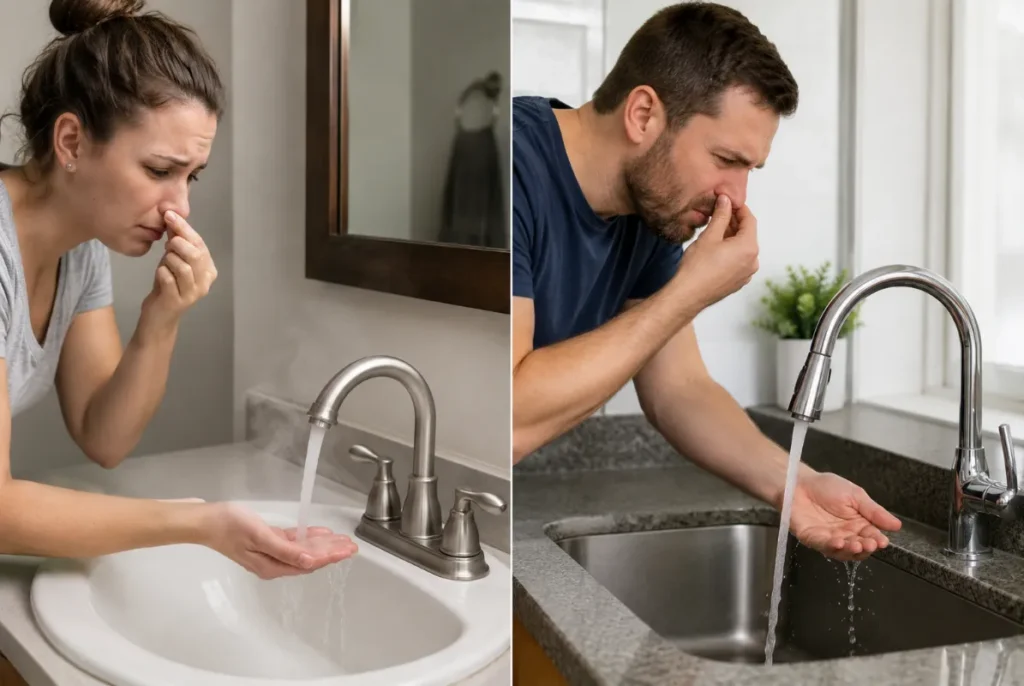
One of the most useful first questions is where the odor occurs.
| What you notice | Possible source to investigate |
| Both hot and cold water smell | Incoming well water, well, plumbing, or treatment equipment |
| Only hot water smells | Water heater or anode-related conditions |
| Odor appears only after treatment equipment | Treatment equipment or downstream plumbing |
| Only one faucet smells | Local plumbing, fixture, or nearby drain |
| Smell is strongest initially and then fades | Stagnant water or a localized condition may be involved |
| Smell remains while water continues running | Incoming water becomes more important to evaluate |
These are clues, not diagnoses. Public-health guidance similarly recommends comparing hot and cold water and treated versus untreated water to help narrow the source.
What If Only the Hot Water Smells Like Rotten Eggs?
When cold water smells normal but hot water has a strong sulfur odor, the water heater may be the source.
Possible contributors include:
- Sulfur-related bacterial activity inside the tank
- Reactions involving the sacrificial anode rod
- Conditions within the heater that make an existing sulfur issue more noticeable
Before installing whole-home odor treatment, it makes sense to determine whether the incoming cold water actually has the same problem.
If the anode is confirmed as the source, the company provides information about powered anode rods for water heaters. The exact water-heater service, compatibility, and installation process should be confirmed before scheduling.
What If Both Hot and Cold Water Smell?
When the odor appears throughout the house in both hot and cold water, investigate farther upstream.
Possible sources include:
- Hydrogen sulfide in the groundwater
- Sulfur bacteria in the well
- Household plumbing
- Existing treatment equipment
Testing becomes particularly useful here because treatment depends on the complete water chemistry, not just the presence of odor.
What If Only One Faucet Smells?
A single affected fixture does not automatically indicate a whole-well problem.
The issue may involve:
- Local plumbing
- Water sitting in a rarely used line
- A fixture
- A nearby drain producing an odor that seems to come from the water
Checking additional fixtures can help determine whether the issue is localized or affects the entire home.
Why Does the Sulfur Smell Sometimes Go Away After the Water Runs?
Water that has been sitting in plumbing can smell stronger when the faucet is first opened. Local bacterial activity or stagnant water may contribute to that pattern.
If the odor continues consistently as fresh water enters the house, the incoming well water becomes a more important source to evaluate.
Again, this pattern narrows the possibilities but does not provide a definitive diagnosis.
Should Well Water Be Tested When It Smells Like Sulfur?
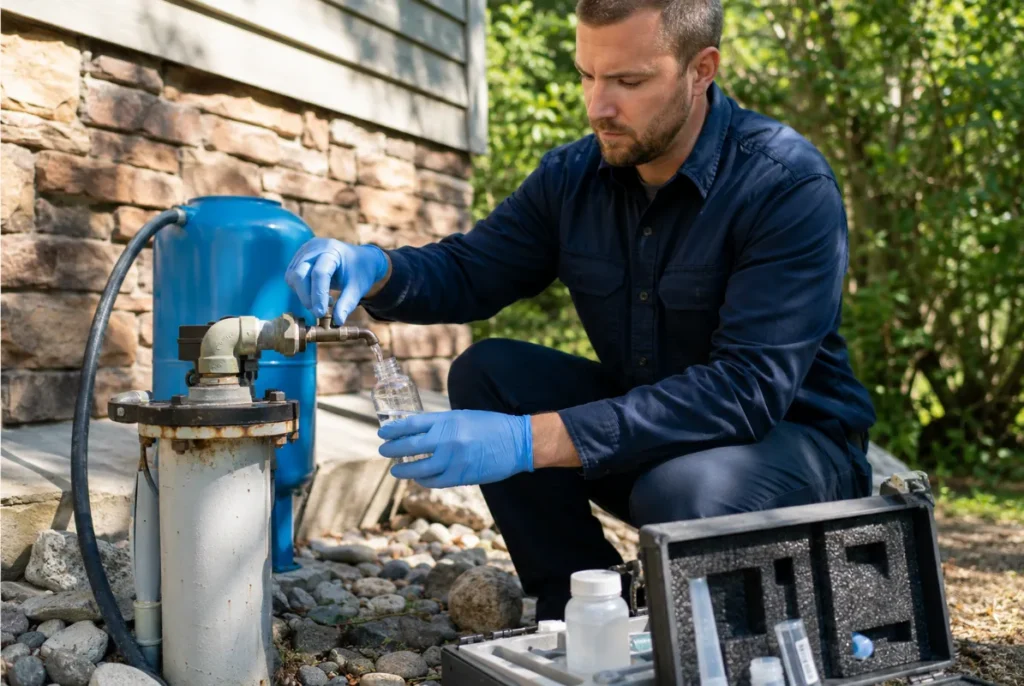
Testing is especially useful when the odor is new, persistent, strong, or accompanied by another change in well-water quality.
Virginia recommends additional testing following unexplained changes in the taste, appearance, or overall quality of private-well water.
Testing the Sulfur Problem
Hydrogen sulfide is a gas and can escape from water, which can make sample handling important when trying to measure it accurately.
Testing or evaluation may consider:
- Hydrogen sulfide
- pH
- Iron
- Manganese
- Hardness
- Sulfate
- Other factors affecting treatment design
The exact test panel depends on the property and suspected source.
Advanced Water Systems’ public testing information does not currently confirm direct hydrogen sulfide testing, so homeowners should ask which sulfur-odor evaluations are available when scheduling.
Testing for Other Well-Water Concerns
A sulfur smell does not eliminate the need to consider broader well-water quality.
Virginia’s recommended private-well testing includes parameters such as:
- Total coliform and E. coli
- Nitrate and nitrite
- pH
- Hardness
- Iron
- Manganese
- Sulfate
- Turbidity
- Several additional inorganic and radiological parameters depending on circumstances
Advanced Water Systems lists several water-testing services for Virginia homes and businesses, including presence/absence testing for total coliform and E. coli and analysis for selected substances.
Can a Water Softener Remove Rotten-Egg Smell?
A standard water softener should not automatically be treated as a sulfur-removal system.
Water softeners are primarily designed to address hardness minerals such as calcium and magnesium. Hydrogen sulfide is a different water-quality issue.
Some homes may have several problems at once, including:
- Hardness
- Iron
- Manganese
- Sulfur odor
In those situations, treatment may require more than one function or carefully selected equipment.
If your home has sulfur odor along with hardness or staining, the existing article about choosing treatment when your water has more than one problem provides additional context.
Will a Carbon Filter Remove Sulfur Smell?
Activated carbon can help with hydrogen sulfide odor in some water conditions, but it is not the right solution for every sulfur problem.
Granular activated carbon is used to reduce certain objectionable tastes and odors, including hydrogen sulfide in appropriate applications.
However, treatment effectiveness can depend on:
- Hydrogen sulfide concentration
- Flow rate
- Contact time
- Other substances in the water
- Filter capacity
- Maintenance
Strong or persistent sulfur problems may require a different treatment process before carbon filtration.
Which Treatments May Help With Rotten-Egg-Smelling Well Water?
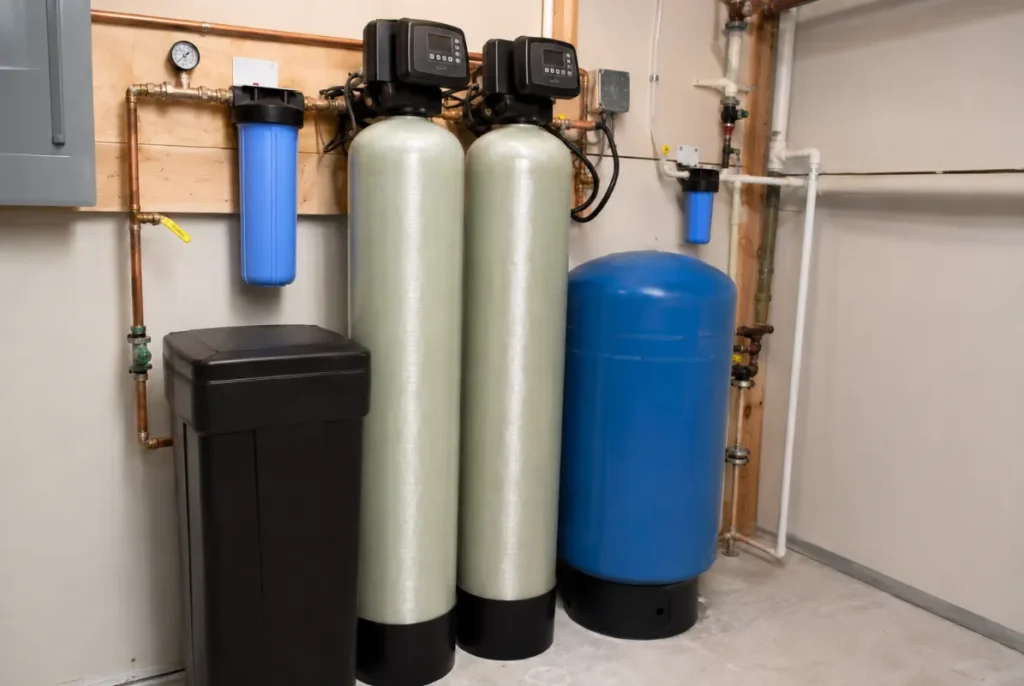
The right treatment depends on where the odor originates and what the water test shows.
Oxidation and Filtration
Oxidation is commonly used for hydrogen sulfide treatment. The process converts dissolved hydrogen sulfide into a form that can then be removed by filtration.
The specific process may depend on:
- Hydrogen sulfide level
- Iron
- Manganese
- pH
- Household flow requirements
- Other characteristics of the water
The important point for homeowners is that sulfur treatment needs to be designed around the whole water chemistry.
Activated Carbon
Carbon may be appropriate for certain lower-level odor problems or as part of a larger treatment system. It requires maintenance and adequate capacity for the conditions being treated.
Well or Plumbing Disinfection
When sulfur bacteria are contributing to the problem, disinfection of the well or plumbing may sometimes be considered.
This should not be treated as a universal permanent fix. If conditions that support bacterial growth remain, the odor may return.
Detailed DIY chlorination instructions are also inappropriate when the well construction, water chemistry, and required disinfectant concentration are unknown. A qualified well or water professional should determine the appropriate procedure.
Water-Heater-Specific Solutions
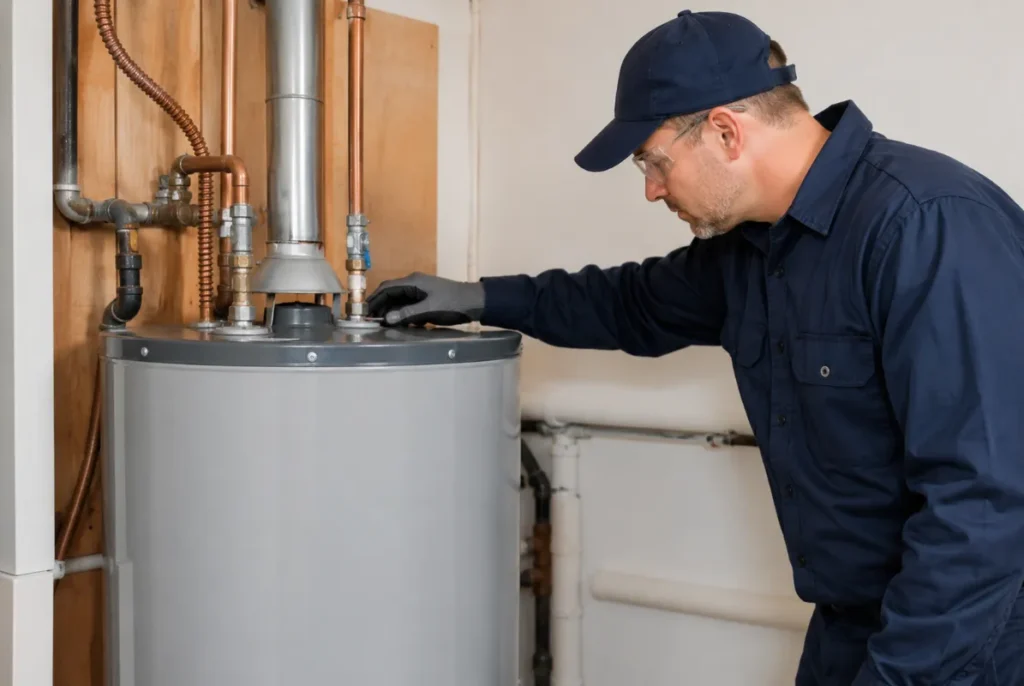
If testing and troubleshooting point to the water heater rather than the incoming well water, whole-home sulfur filtration may not be necessary.
Potential solutions depend on the heater and source of the reaction. The existing powered anode rod information is relevant when the conventional anode is confirmed as the source.
More Specialized Whole-Home Treatment
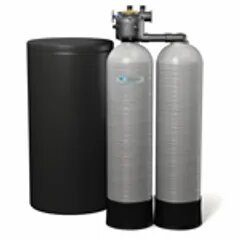
Persistent hydrogen sulfide may require specialized oxidation, backwashing, aeration, or other treatment depending on the water conditions. Aeration, for example, can remove gases such as hydrogen sulfide by mixing air with the water and venting the gas appropriately.
Specific equipment should not be selected until the source and water chemistry are known.
What Determines Which Sulfur Treatment You Need?
The best treatment is determined by the source of the odor and the complete water chemistry, not by the smell alone.
Important factors can include:
- Whether hot water, cold water, or both smell
- Hydrogen sulfide level
- Iron
- Manganese
- pH
- Hardness
- Bacterial conditions
- Household water demand
- Existing filtration or softening equipment
- Water-heater conditions
This is why a system that works well in one private-well home may not be the right choice for another.
A broader overview of well-water treatment selected from test results can help homeowners understand why several technologies may be considered for different water-quality problems.
When Should You Contact a Water-Treatment Professional?
Consider professional testing or evaluation when:
- The sulfur odor is persistent or becoming stronger
- Both hot and cold water are affected
- The odor appeared suddenly in a previously trouble-free well
- You also notice black, orange, or other staining
- There is slime or unusual buildup
- Existing treatment no longer controls the odor
- The smell returns shortly after previous treatment
- You cannot tell whether the source is the well, plumbing, treatment equipment, or water heater
A professional can evaluate the problem without assuming that every rotten-egg smell needs the same filter.
Request Well-Water Testing and Odor Evaluation in Central Virginia
If your well water smells like rotten eggs, identify the source before investing in treatment. The correct solution may be very different depending on whether the odor begins in the groundwater, well, plumbing, existing equipment, or water heater.
Advanced Water Systems – Kinetico Richmond provides water testing and water-treatment services for residential and commercial properties throughout its listed Central Virginia and surrounding Virginia service areas.
Call (877) 609-2837 or contact Advanced Water Systems to discuss water testing and an odor evaluation.
Frequently Asked Questions
Is sulfur-smelling well water safe to drink?
The odor alone cannot determine whether the water is safe. Hydrogen sulfide and sulfur bacteria are often nuisance water-quality issues, but Virginia recommends testing private wells when an unexplained change in water quality, taste, or appearance occurs.
Why does only my hot water smell like rotten eggs?
A hot-water-only odor can indicate that the water heater is contributing to hydrogen sulfide production. Sulfur bacteria or reactions involving the heater’s anode rod are possible causes.
Can a water softener get rid of the sulfur smell?
A standard softener is designed primarily for hardness and should not automatically be considered a sulfur treatment. If hardness, iron, manganese, and sulfur occur together, treatment needs to account for each condition.
Does a carbon filter remove rotten-egg odor?
Activated carbon can reduce hydrogen sulfide odor in some applications, but its suitability depends on the concentration, water chemistry, flow rate, and filter capacity.
Why did my well water suddenly start smelling like sulfur?
Possible causes include changes in the well or groundwater, bacterial activity, plumbing or treatment equipment, or the water heater. An unexplained new odor is a reason to consider water testing rather than assuming the cause from smell alone.
Do I need a whole-home sulfur filter?
Not necessarily. If only the hot water smells, the water heater may be the source. If the odor affects hot and cold water throughout the house, whole-home treatment may be considered after the source and water chemistry are evaluated.
External Sources
- Virginia Department of Health, Guidance on Testing Your Private Well Water
https://www.vdh.virginia.gov/environmental-health/onsite-sewage-water-services-updated/organizations/private-well-water-information/guidance-on-testing-your-private-well-water/
Used for Virginia private-well testing recommendations and guidance concerning unexplained changes in water quality. - Minnesota Department of Health, Hydrogen Sulfide and Sulfur Bacteria in Well Water
https://www.health.state.mn.us/communities/environment/water/wells/waterquality/hydrosulfide.html
Used to verify common hydrogen sulfide sources and the hot-water versus cold-water diagnostic approach. - Penn State Extension, Hydrogen Sulfide (Rotten Egg Odor) in Water Wells
https://extension.psu.edu/hydrogen-sulfide-rotten-egg-odor-in-water-wells/
Used to verify hydrogen sulfide treatment concepts including oxidation, filtration, carbon, and disinfection. - Minnesota Department of Health, Water Treatment Using Carbon Filters
https://www.health.state.mn.us/communities/environment/hazardous/topics/gac.html
Used to verify that granular activated carbon can reduce hydrogen sulfide odor in appropriate applications.