



What Do Black, Orange, or Blue-Green Water Stains Mean?
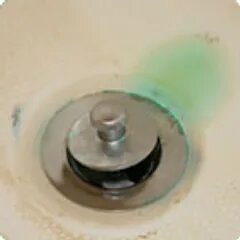
Water-stain color can provide a useful clue about what is happening in your water or plumbing. Orange or reddish-brown stains often point toward iron. Black or dark-brown stains may involve manganese, sometimes along with iron. Blue-green stains commonly suggest copper being released from plumbing, often because the water is corrosive.
The important word is clue. A stain cannot tell you how much of a substance is present or whether the source is the groundwater, household plumbing, or both.
That is why recurring stains are better handled with water testing before choosing stain treatment than by selecting equipment based on color alone.
Can Water-Stain Color Tell You What Is in Your Water?
It can narrow the possibilities, but it cannot confirm the cause.
Virginia Department of Health specifically recommends considering tests for iron, copper, and manganese when private-well users notice stained plumbing fixtures or laundry. VDH also recommends additional testing when there is an unexplained change in the appearance, taste, odor, or quality of private-well water.
A useful starting point is:
| Stain color | Possible cause | What may need testing or inspection |
| Orange or reddish-brown | Iron | Iron, manganese, pH, hardness, source water and plumbing |
| Black or dark brown | Manganese, sometimes iron plus manganese | Manganese, iron, pH |
| Blue-green | Copper corrosion | Copper, pH, corrosion conditions, household plumbing |
| White or chalky | Hardness scale | Hardness |
| Mixed or unusual colors | More than one issue may be present | Broader water evaluation |
These are general diagnostic directions, not guaranteed diagnoses.
What Do Orange or Reddish-Brown Water Stains Mean?
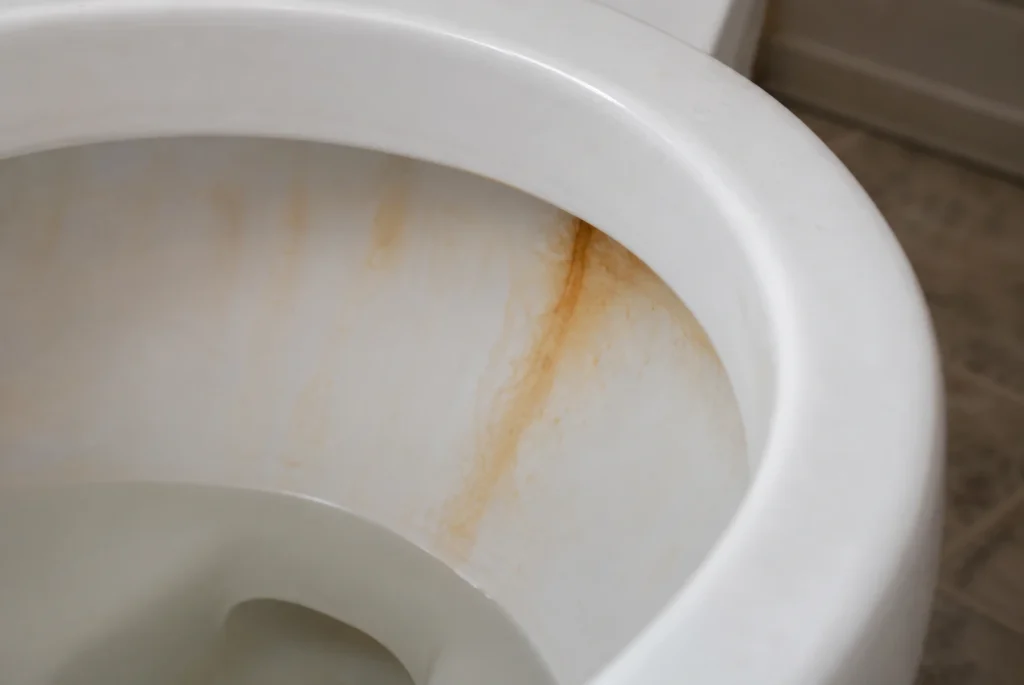
Orange, rusty, or reddish-brown staining commonly points toward iron.
Virginia Tech explains that iron in household water commonly causes reddish-brown staining on laundry, porcelain, dishes, utensils, and glassware. EPA’s secondary drinking-water guidance similarly associates iron with rusty color, sediment, metallic taste, and reddish or orange staining.
Why Can Clear Water Leave Orange Stains Later?
One confusing feature of iron is that the water can initially look clear.
Dissolved ferrous iron may remain invisible when it first comes from the faucet. After exposure to air, chlorine, or another oxidant, it can change into an oxidized form that creates red-brown particles or stains. Virginia Tech describes the same process for manganese, which may produce darker particles.
That means a homeowner can reasonably say:
“The water looks clear, but my toilet still turns orange.”
Those two observations are not contradictory.
Can Orange Staining Come From Plumbing?
Yes.
Iron does not always come directly from the well. Virginia Tech notes that corroding iron or galvanized-steel pipes can also introduce iron into household water.
That is why testing and inspection should distinguish between:
- Iron already present in the source water
- Iron released from plumbing or equipment
- Dissolved iron
- Oxidized particulate iron
- Iron-related bacterial buildup
Those differences can affect which treatment is appropriate.
What Do Black or Dark-Brown Water Stains Mean?
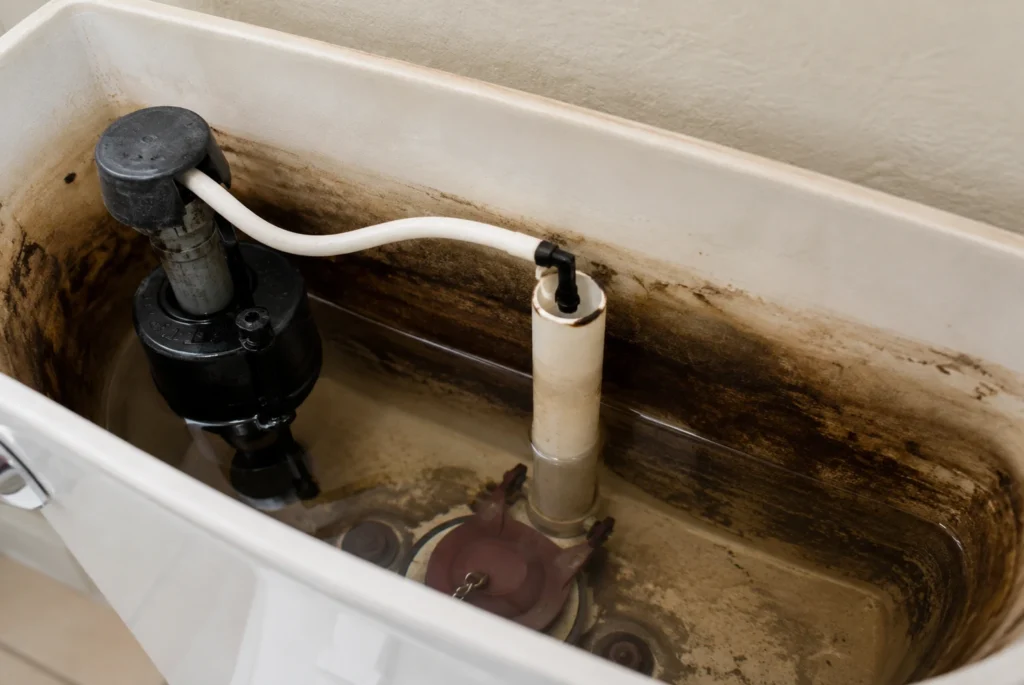
Black or brownish-black staining commonly points toward manganese, although iron and manganese can occur together.
Virginia Tech describes manganese as a common cause of brownish-black staining on household fixtures and laundry. EPA likewise associates manganese with black-to-brown color and black staining.
Why Can Manganese Appear After the Water Sits?
Like iron, manganese may be dissolved when the water first leaves the faucet.
As it reacts with oxygen or another oxidant, darker particles can form. This is why water that initially looks clear may later leave black or dark-brown deposits.
Can Iron and Manganese Be Present Together?
Yes.
Homes do not necessarily have a single isolated water-quality problem. Iron and manganese are chemically similar and may occur together. That can create staining that is harder to classify as simply “orange” or “black.”
If staining appears alongside hardness, odor, or several other symptoms, the company’s article on choosing treatment when your water has several problems at once provides broader context.
Does Black Staining Automatically Mean the Water Is Unsafe?
No, but the stain itself cannot tell you the concentration.
EPA maintains a secondary drinking-water guideline of 0.05 mg/L for manganese because of aesthetic effects such as black staining and metallic taste. Virginia Tech notes that staining can occur even below the secondary guideline.
The useful takeaway is not “black stains are harmless” or “black stains are dangerous.”
It is:
Test the water so you know what is actually present and at what level.
What Do Blue-Green Water Stains Mean?
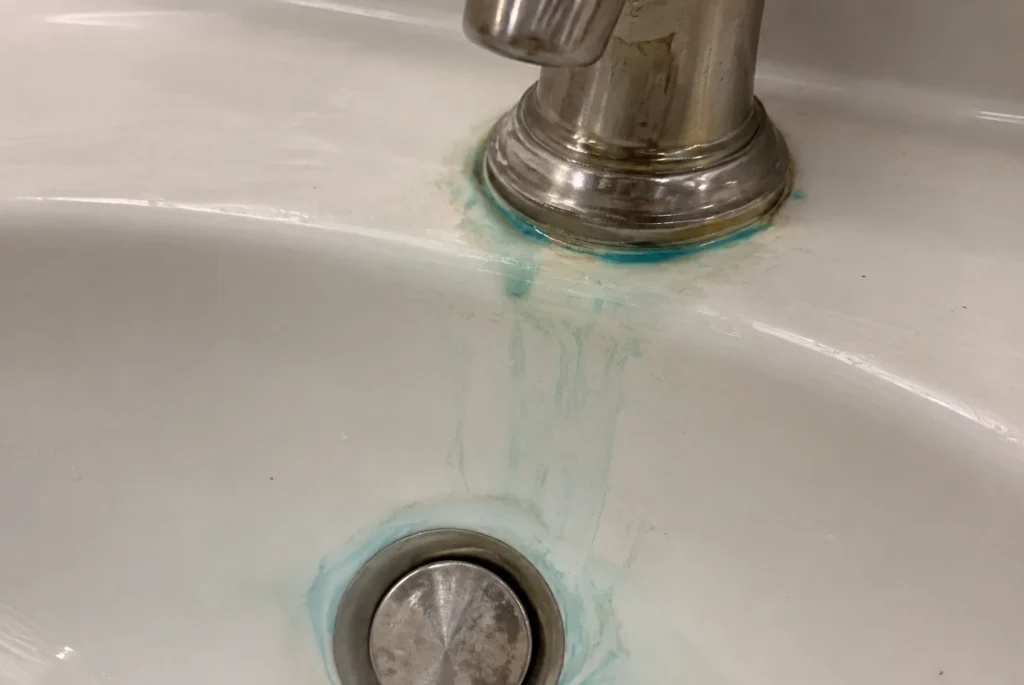
Blue-green staining often suggests copper corrosion rather than a mineral entering directly from the well.
EPA identifies copper as a cause of metallic taste, blue-green color, and blue-green staining. Its guidance also notes that corrosion of copper plumbing can affect water color and household fixtures.
Why Would Copper Be Coming From the Pipes?
Copper plumbing can release copper into water when corrosion occurs.
Several water characteristics can influence corrosion, including:
- pH
- Alkalinity
- Hardness
- Chloride and sulfate
- Temperature
- Water stagnation
- Overall corrosivity
The presence of blue-green staining does not automatically mean the original source water contains high copper.
The copper may be entering after the water reaches the home’s plumbing.
Can Acidic Water Cause Blue-Green Staining?
It can contribute.
Low-pH water is one condition associated with corrosivity, and VDH recommends testing pH and corrosion-related parameters when plumbing corrosion is suspected.
This is an important distinction because a standard sediment filter or softener does not correct corrosive water simply because the visible symptom is a stain.
When testing confirms low-pH or corrosive conditions, treatment for acidic or corrosive water may be more relevant than ordinary filtration.
Should Blue-Green Stains Be Taken More Seriously Than a Cosmetic Problem?
They should be investigated.
Copper has both aesthetic and health-related standards, and corrosion may raise concerns involving other plumbing metals as well. VDH recommends considering pH, lead, and copper when corrosion or lead-containing plumbing is a concern.
That does not mean every blue-green stain indicates unsafe copper or lead levels.
It means testing is more useful than guessing from color.
What About White Water Spots or Chalky Deposits?
White scale is different from the colored metal staining discussed above.
White or chalky deposits more commonly point toward hardness minerals such as calcium and magnesium.
If the main symptoms are:
- White scale
- Mineral rings
- Spotted glassware
- Chalky faucet buildup
then the relevant question may be whether the home needs hard-water treatment for white scale and spotting rather than an iron or manganese filter.
A softener and filter perform different jobs, which is why it helps to understand whether your water problem needs softening or filtration.
Can the Same Home Have More Than One Stain Color?
Yes. Multiple stain colors can indicate multiple water or plumbing conditions.
Examples may include:
- Iron plus manganese
- Hardness plus iron
- Acidic water plus copper corrosion
- Source-water minerals combined with household plumbing corrosion
- Sediment plus staining metals
This is another reason a treatment recommendation should not be based on a single photograph.
A homeowner with orange staining and white scale, for example, may be dealing with both iron and hardness. A blue-green stain plus pinhole leaks may point toward a different corrosion concern.
One piece of equipment should not be assumed to solve every symptom.
Is Stained Water Unsafe to Drink?
Staining alone cannot tell you whether water is safe or unsafe.
Some stain-causing substances are commonly discussed under secondary aesthetic standards, while others can become health concerns at higher concentrations.
For example:
- EPA’s secondary standard for iron is 0.3 mg/L, associated with rusty color, sediment, metallic taste, and reddish or orange staining.
- EPA’s secondary standard for manganese is 0.05 mg/L, associated with black-to-brown color and staining.
- EPA’s secondary standard for copper is 1.0 mg/L for aesthetic effects such as metallic taste and blue-green staining. Public-water systems also have a separate health-based copper action level under the Lead and Copper Rule.
The stain cannot tell you which concentration is present.
That requires testing.
Should You Test Well Water When Staining Appears?
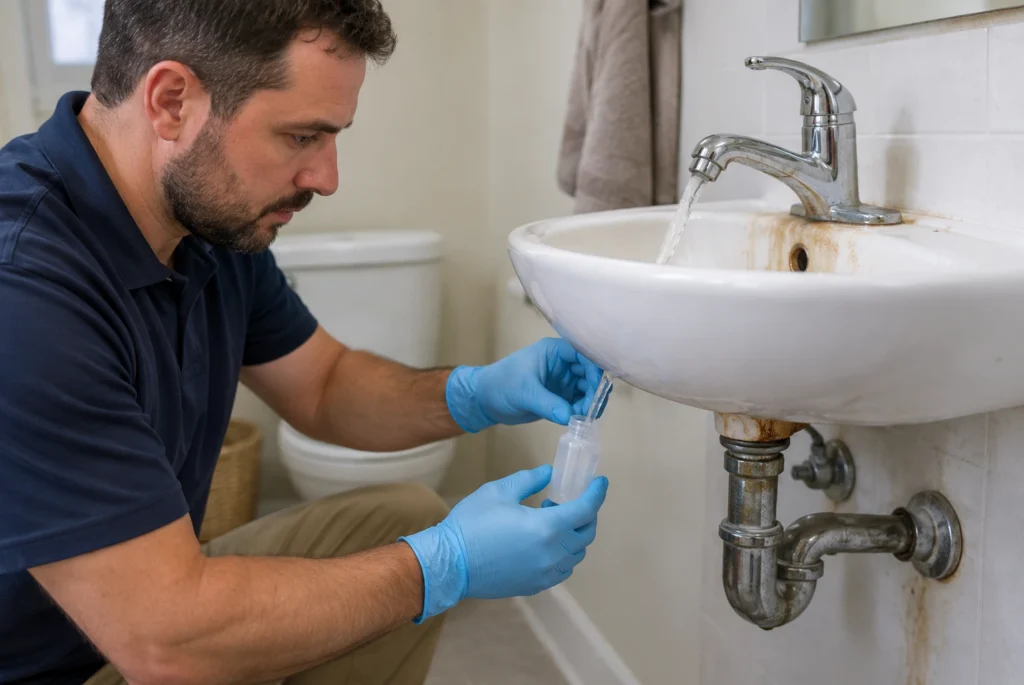
Yes, especially when the staining is new, recurring, worsening, or unexplained.
Virginia Department of Health specifically identifies stained plumbing fixtures or laundry as a reason to consider testing for:
- Iron
- Copper
- Manganese
Depending on the symptoms and property, a broader evaluation may also consider:
- pH
- Hardness
- Alkalinity
- Lead
- Turbidity
- Other water-quality parameters
Advanced Water Systems lists water testing among its residential and commercial services. Its public testing information includes several water-quality parameters, but the exact scope of testing for a particular staining complaint should be confirmed when scheduling.
Why Testing Matters Before Treatment
The form of the contaminant can matter as much as the amount.
Virginia Tech distinguishes between:
- Dissolved iron or manganese
- Oxidized particulate forms
- Colloidal or organically complexed forms
- Iron- or manganese-related bacterial buildup
Different forms may require different treatment approaches.
That is why “orange stain” is not enough information to choose a filter.
What Treatments May Help With Colored Water Stains?
The correct treatment depends on what testing confirms, where the substance originates, and the form in which it is present.
Treatment for Iron
Depending on the water chemistry and form of iron, treatment categories may include:
- Particle filtration
- Oxidation followed by filtration
- Ion exchange under appropriate conditions
- Other iron-specific treatment
Virginia Tech notes that treatment selection varies based on the amount and form of iron and manganese present.
Do not assume that every orange stain requires the same iron filter.
Treatment for Manganese
Manganese treatment can also vary according to:
- Concentration
- pH
- Whether the manganese is dissolved or oxidized
- Presence of iron
- Other water chemistry
Possible approaches may involve oxidation, filtration, specialty media, or ion exchange under particular conditions.
Treatment for Blue-Green Corrosion Staining
When testing points toward copper corrosion, the goal is not simply to trap blue-green particles.
The underlying corrosive condition may need to be addressed.
Depending on the findings, that may involve:
- Water-chemistry correction
- Acid neutralization when low pH is confirmed
- Plumbing evaluation
- Replacement of damaged plumbing when necessary
A water-treatment company can evaluate water chemistry, but actual plumbing repair may require a plumbing professional depending on the situation.
Why Treatment Order Matters
If a home has more than one issue, the systems may need to operate in a specific sequence.
For example, a home could have:
- Sediment
- Iron
- Hardness
- Low pH
- Drinking-water concerns
Installing equipment without understanding the full water chemistry can leave one problem untreated or make another system harder to maintain.
When Should You Contact a Water-Treatment Professional?
Consider professional evaluation when:
- Stains return soon after cleaning
- Several fixtures are affected
- Laundry is becoming stained
- Clear water develops color after sitting
- Black or orange particles appear
- A metallic taste develops
- Blue-green staining appears near copper plumbing
- You also notice corrosion or pinhole leaks
- Existing treatment no longer controls the staining
- Several colors or symptoms appear at the same time
The useful goal is to identify the source before choosing the equipment.
Request Water Testing for Recurring Stains in Central Virginia
Orange, black, and blue-green stains can provide useful clues, but a water test is the better way to determine what is causing them.
Advanced Water Systems – Kinetico Richmond provides water testing and residential water-treatment services throughout Richmond and its listed Central and Southern Virginia service area.
Call (877) 609-2837 or request water testing for recurring stains to discuss the color, location, and other water problems you are noticing.
Frequently Asked Questions
What causes orange water stains?
Iron is a common cause of orange or reddish-brown staining. Dissolved iron may initially be invisible and then oxidize after exposure to air, producing particles and stains. Corroding iron or galvanized plumbing can also contribute.
What causes black stains from well water?
Black or brownish-black staining commonly suggests manganese, although iron and manganese can occur together. Testing is necessary because color alone cannot confirm the cause or concentration.
Why does clear well water leave stains later?
Dissolved iron or manganese can remain invisible while the water is fresh from the tap. After exposure to air or another oxidant, those dissolved metals can form colored particles that stain fixtures or laundry.
What causes blue-green stains in a sink or bathtub?
Copper released through plumbing corrosion is a common cause of blue-green staining. Water chemistry, including pH and corrosivity, can influence how much copper enters the water.
Can a water softener remove iron or manganese stains?
Sometimes under specific water conditions, a softener should not automatically be treated as an iron- or manganese-removal system. The amount, form, pH, hardness, and other water chemistry should be evaluated first.
Should I test my water if staining suddenly appears?
Yes. VDH recommends additional private-well testing when water changes unexpectedly and specifically lists iron, copper, and manganese testing when fixtures or laundry become stained.
External Sources
- Virginia Tech, Virginia Household Water Quality Program: Iron and Manganese in Household Water
Explains dissolved and particulate iron and manganese, stain colors, testing, and treatment considerations.
Virginia Tech iron and manganese guidance - Virginia Department of Health, Private Well Program
Provides Virginia-specific private-well testing guidance and identifies iron, copper, and manganese as relevant tests when plumbing fixtures or laundry are stained.
Virginia Department of Health Private Well Program - U.S. EPA, Secondary Drinking Water Standards
Used to verify aesthetic standards and staining effects associated with iron, manganese, copper, and corrosivity.
EPA secondary drinking water standards - Virginia Tech, 10 Tips for Managing Your Private Water Supply
Associates orange/black staining with iron and manganese and blue stains or pinhole leaks with pH, copper, and lead testing.
Virginia Tech private water supply tips