
How Much Does a Home Water Filtration System Cost? Factors That Affect the Price
There is no single price for a home water-filtration system because the term can describe anything from treatment at one kitchen faucet to a customized system serving every fixture in the house. The final cost depends on the water problem, treatment scope, household demand, equipment required, installation conditions, and future maintenance.
A useful estimate should explain more than the total price. It should identify what the system is intended to treat, what equipment and installation are included, and what the homeowner will need to replace or maintain later.
For that reason, comparing filtration estimates should begin with the water itself rather than a product name or advertised package.
Why Is There No Single Price for a Home Water-Filtration System?
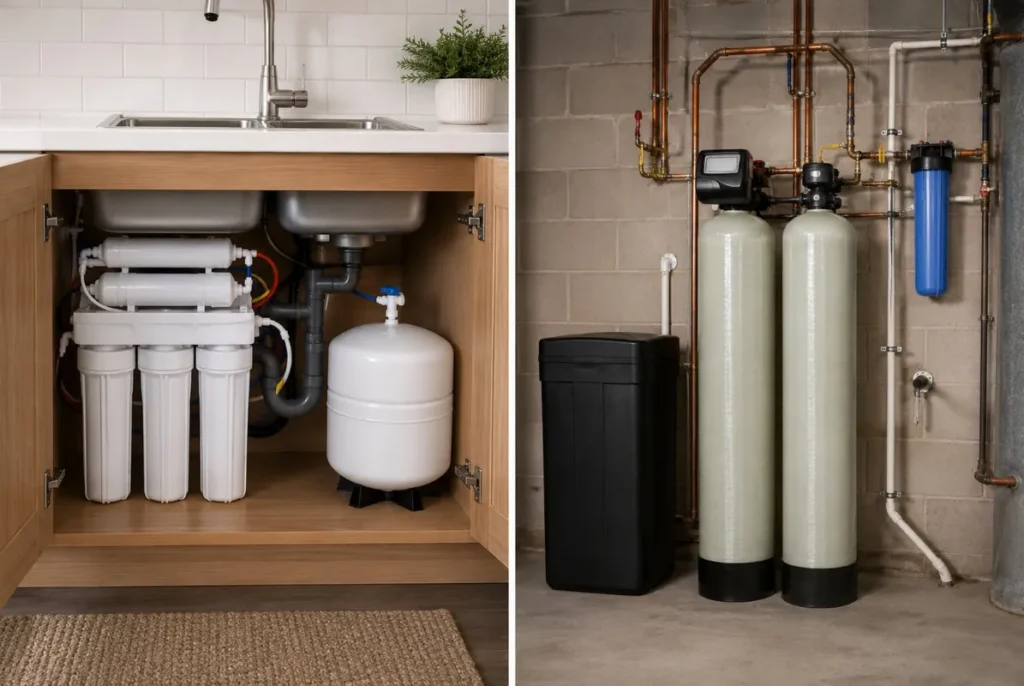
Two homeowners may both ask for a water filter while needing completely different solutions.
One person may want to improve the taste of drinking water at the kitchen sink. Another may be dealing with sediment, hardness, acidity, staining, or odor throughout the property. The second project may require larger equipment, more plumbing work, and multiple treatment stages.
The first question is therefore not simply, “How much does a filter cost?”
It is:
What needs to be treated, and where does the treatment need to occur?
Drinking-Water Treatment at One Location
A point-of-use system treats water at a particular fixture, usually the kitchen sink. EPA defines point-of-use reverse osmosis as treatment connected to a single fixture rather than all water entering the property.
Possible options include:
- Under-sink carbon filtration
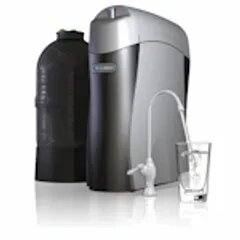
- Under-sink reverse osmosis
- A dedicated drinking-water faucet
- A connection to a refrigerator or ice maker
- Multiple filtration stages for a specific drinking-water concern
Because these systems serve a limited area, they generally involve less equipment and plumbing than whole-home treatment. That does not automatically make one the right choice. It works only when treating drinking and cooking water addresses the homeowner’s actual goal.
Readers deciding between these treatment scopes can review whether to treat one faucet or the entire home.
Whole-Home Water Treatment
A point-of-entry or whole-home system treats water as it enters the property, before it reaches household fixtures.
Whole-home treatment may involve:
- Sediment filtration
- Carbon filtration
- Water softening
- Acid neutralization
- Iron or manganese treatment
- Odor treatment
- UV treatment
- Multiple systems installed in sequence
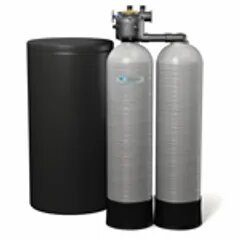
A water softener is not the same as a general water filter. A softener is designed primarily to address hardness minerals, while other filtration equipment may address particles, tastes, odors, or specific contaminants.
A property may need one technology, a combination of technologies, or only drinking-water treatment. Professional water testing before selecting a system can help avoid paying for equipment that does not address the actual concern.
What Factors Affect the Cost of a Water-Filtration System?
The following factors usually have the greatest effect on the project.
1. The Problem Shown by the Water Test
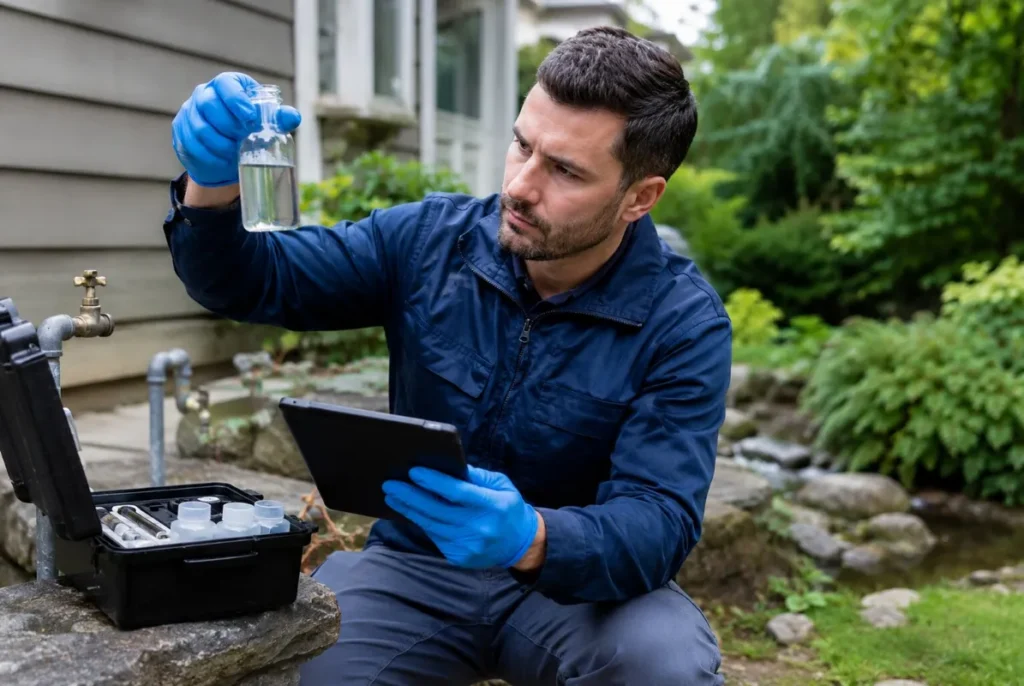
Different water problems require different treatment technologies.
A filter intended to reduce sediment does not perform the same job as a softener, acid neutralizer, UV system, carbon filter, or reverse-osmosis membrane.
Testing may help determine whether the concern involves:
- Hardness
- Sediment
- Chlorine or chloramine
- Iron or manganese
- Acidity
- Sulfur-like odor
- Bacteria
- Lead or another specific substance
- More than one condition
Not every filter can reduce every contaminant. NSF recommends choosing a treatment product based on water-test results and checking whether the specific model is certified for the reduction claim being made.
A quote prepared without understanding the water may be based on an incomplete assumption.
2. Point-of-Use Versus Whole-Home Treatment
Treating water at one faucet is a different project from treating all water entering the home.
An under-sink system may require:
- A filtration unit
- A dedicated faucet
- Under-sink plumbing
- A storage tank for some reverse-osmosis systems
- A refrigerator or ice-maker connection when requested
- A drain connection for reverse osmosis
Whole-home treatment may require:
- Larger tanks or filter housings
- A bypass assembly
- Connection to the main water line
- Adequate service flow for the household
- Drain access for some equipment
- Electrical access for some systems
- Space for maintenance and media replacement
- Several treatment stages
The company offers both drinking-water filtration and reverse-osmosis options and whole-home water-filtration options. The appropriate scope depends on where the problem occurs and which water uses the homeowner wants treated.
3. Municipal Water Versus Private-Well Water
The water source does not create a fixed price by itself, but it affects what must be evaluated.
Municipal-water customers may be concerned about:
- Chlorine or chloramine
- Taste and odor
- Sediment
- Hardness
- Household plumbing
- A specific contaminant
Private-well owners may need to evaluate:
- Hardness
- Acidity
- Iron
- Manganese
- Sediment
- Odor
- Bacteria
- Other conditions associated with the specific property
It would be inaccurate to assume that all city-water homes need one system or that all wells need a more complex system. Treatment should be selected for the home’s actual water conditions.
4. Household Water Demand
Whole-home equipment must handle the amount of water the household may use at one time.
Sizing considerations may include:
- Number of residents
- Number of bathrooms
- Simultaneous showers
- Washing machines and dishwashers
- Large tubs
- High-flow fixtures
- Pipe size
- Expected peak use
An undersized system may restrict flow or fail to perform as intended during busy periods. An unnecessarily oversized system may increase the project cost without adding meaningful value.
5. One Treatment Stage Versus Several
Some concerns may be addressed with one appropriately selected system. Others may require treatment in a particular sequence.
For example, a private well could potentially require sediment treatment before another form of conditioning or filtration. A homeowner might then choose a separate under-sink system for drinking water.
That example does not mean every well needs several pieces of equipment. It shows why the number and order of treatment stages can affect cost.
6. Installation Access and Plumbing Conditions
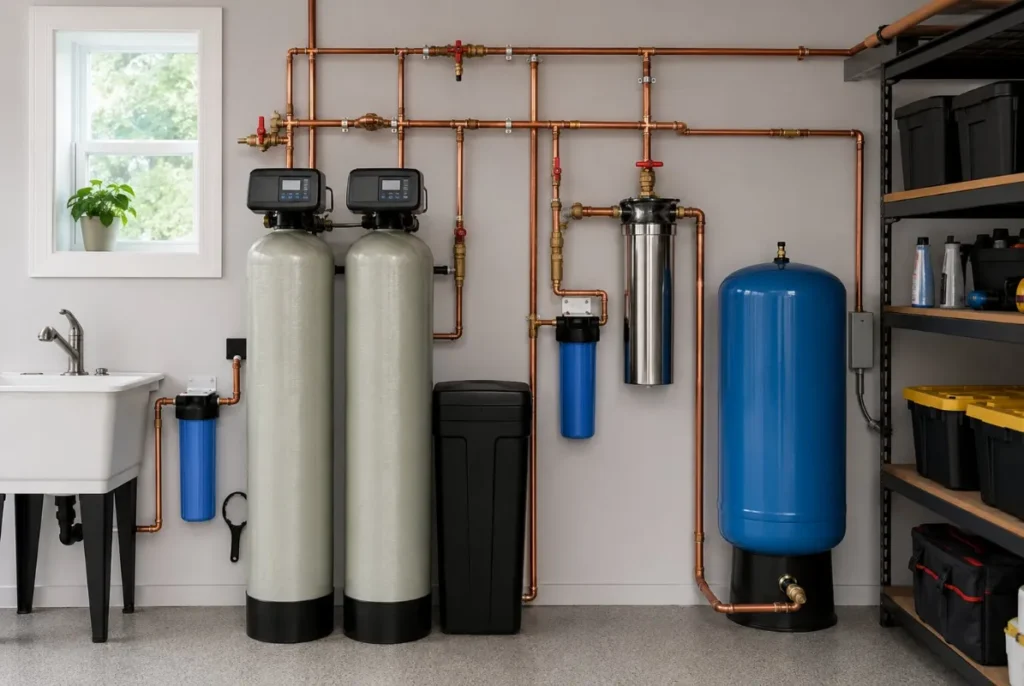
The same equipment can involve different installation requirements in different homes.
Factors may include:
- Pipe material
- Pipe size
- Equipment location
- Available floor and wall space
- Basement or crawlspace access
- Drain availability
- Electrical access
- Existing bypass valves
- Condition of the plumbing
- Removal of older equipment
- Connections to a refrigerator or separate faucet
An estimate should clarify which installation work is included and which changes would be additional.
7. Equipment Design and Features
Systems within the same general category may have different configurations and capacities.
Possible differences include:
- Single-tank or twin-tank operation
- Electric or non-electric operation
- Cartridge or backwashing filtration
- Storage capacity
- Service-flow capability
- Shutoff or monitoring features
- Specialized cartridges
- Mineral-addition options
- Product certifications
These features should be evaluated by usefulness, not by assuming that more features always produce better water.
8. Replacement Parts and Routine Maintenance
The installed price is only one part of the cost of owning a filtration system.
Depending on the equipment, future expenses may include:
- Filter cartridges
- Reverse-osmosis membranes
- UV lamps
- Salt
- Neutralizing or filtration media
- Sanitization
- Professional service
- Repairs outside warranty coverage
Replacement schedules should come from the instructions for the specific model and the home’s water conditions. EPA notes that filters and membranes must be maintained and replaced as directed to preserve treatment performance.
Homeowners should review questions about owning and maintaining a Kinetico system before comparing lifetime costs.
How Do Different Types of Systems Compare in Cost?
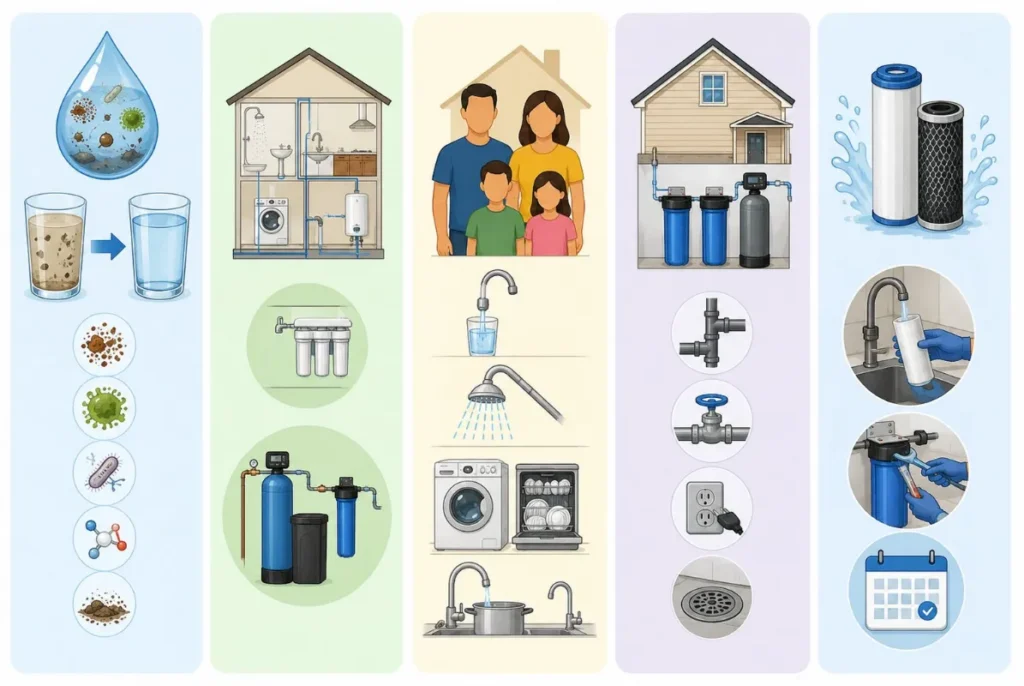
Without company-approved pricing, it is more accurate to compare relative project complexity than to publish generalized dollar ranges.
| System category | Typical treatment scope | Relative project complexity | Main cost factors |
| Faucet or countertop filter | One point | Lower | Cartridge type, capacity, certification |
| Under-sink filtration | One drinking-water location | Lower to moderate | Filter stages, faucet, plumbing |
| Under-sink reverse osmosis | Drinking and cooking water | Moderate | Membrane, storage, drain, faucet |
| Whole-home sediment filtration | Entire home | Moderate | Flow rate, housing, cartridge or backwashing design |
| Whole-home carbon filtration | Entire home | Moderate to higher | Media capacity, flow rate, installation |
| Water softener | Entire home | Moderate to higher | Capacity, configuration, plumbing |
| Multi-stage well-water treatment | Entire home | Higher | Number of conditions and treatment stages |
| Whole-home reverse osmosis | Entire home | Higher complexity | Pretreatment, storage, pumps, drainage |
These categories are not price quotes. Actual complexity depends on the property and equipment selected.
Point-of-use reverse osmosis treats drinking water at a limited fixture, while whole-home reverse osmosis can require additional components such as pretreatment, storage, and pumping.
What Should a Professional Water-Filtration Estimate Include?
A useful estimate should identify the problem being addressed, the complete system configuration, the installation work, and the expected maintenance.
Homeowners should be able to find or request the following information.
Equipment and System Configuration
The proposal should identify:
- Equipment category
- Manufacturer and model
- Treatment stages
- Capacity or applicable flow information
- Point-of-use or whole-home scope
- Optional components
- Which water concern each component addresses
The phrase “complete filtration system” is not specific enough by itself.
Installation and Plumbing Work
The estimate should state whether it includes:
- Standard installation
- Plumbing changes
- Bypass valves
- Drain connections
- Electrical work
- Dedicated faucet installation
- Refrigerator connections
- Removal of old equipment
- Cleanup and disposal
Initial Filters, Membranes, or Treatment Media
Confirm what is installed on the first day and when each component may need replacement.
Warranty and Service Coverage
Ask:
- What equipment is covered?
- Is labor included?
- How long does each form of coverage last?
- Are maintenance requirements tied to coverage?
- Is the warranty transferable?
- Who performs future service?
Do not rely only on the advertised length. The exclusions and responsibilities matter.
Ongoing Maintenance Expectations
The proposal should explain what the homeowner can maintain and which services require a technician.
Items Not Included
Ask for exclusions in writing. A lower initial estimate may omit work or components included in another proposal.
Why Can Two Water-Filtration Quotes Be So Different?
Two estimates may differ because they are not proposing the same treatment scope, equipment capacity, installation work, or maintenance support.
Legitimate reasons for a difference include:
- One proposal treats one faucet while the other treats the whole home
- One includes a softener or pretreatment
- The proposed capacities differ
- One includes more plumbing work
- One includes replacement components
- Warranty or labor coverage differs
- One includes ongoing service
- The proposals are based on different assumptions about the water
Before comparing totals, place the details side by side.
| Estimate item | Proposal A | Proposal B | Why it matters |
| Water problem addressed | Both systems should address the same confirmed concern | ||
| Treatment scope | One faucet and the entire home are different projects | ||
| Model and configuration | Shows what is actually being installed | ||
| Service flow or capacity | Helps determine whether the system is properly sized | ||
| Installation included | Clarifies the real project total | ||
| Replacement components | Shows future ownership requirements | ||
| Certification claims | Confirms model-specific performance | ||
| Service requirements | Helps compare ongoing work | ||
| Warranty terms | Coverage and exclusions may differ |
Warning signs may include:
- No evaluation of the water
- No model numbers
- No explanation of what the equipment treats
- Claims that one system “removes everything”
- No replacement schedule
- No information about installation
- Pressure to decide before the proposal is explained
A lower quote is not automatically poor quality, and a higher quote is not automatically better. The proposals must first be made comparable.
Is a More Expensive Water Filter Always Better?
No. A more expensive system is not automatically the best choice for a home.
The system should be:
- Appropriate for the water problem
- Correctly sized
- Properly installed
- Practical to maintain
- Supported by available service
- Certified for any specific contaminant-reduction claims being made
NSF standards cover different treatment functions and contaminant claims. Certification for one claim does not mean that a product reduces every possible substance.
Unnecessary equipment can add expense. An incomplete or undersized system may be less expensive initially but fail to address the concern.
What Ongoing Costs Should Homeowners Ask About?
Before choosing a system, ask about:
Replacement Filters and Membranes
Confirm:
- Which components require replacement
- Model-specific replacement guidance
- Current component availability
- Whether the homeowner or a technician performs the work
- The effect of delayed replacement
Salt or Treatment Media
Water softeners and some treatment systems use salt or replaceable media. Usage and replacement depend on the system, water conditions, and household demand.
UV Lamps and Sanitization
UV equipment may require lamp replacement and other maintenance. A UV system should also be supported by the pretreatment and operating conditions required for that specific model.
Professional Service
Ask whether routine inspection, sanitization, testing, or media replacement requires a service appointment.
Water and Electricity
Some systems use electricity, while others do not. Reverse-osmosis systems also produce a treated stream and a reject-water stream. EPA advises comparing efficiency and maintenance when choosing point-of-use RO equipment.
Repairs and Warranty Exclusions
Clarify which repairs are covered and which are considered routine maintenance.
Is a Home Water-Filtration System Worth the Cost?
A filtration system is most likely to provide useful value when it solves a confirmed concern at the appropriate treatment scope.
The decision may depend on:
- What the test results show
- Whether the concern affects drinking water or the entire home
- Current bottled-water use
- Taste and odor preferences
- Maintenance requirements
- Convenience
- Available service
- Expected time in the home
- Whether the proposed system addresses the stated goal
The system should not be justified with unsupported promises about medical benefits, guaranteed savings, home value, or exact appliance-life extensions.
Should You Buy, Finance, or Rent a Water-Treatment System?
Purchase, financing, rental, and reconditioned-equipment options may have different:
- Initial costs
- Monthly obligations
- Ownership terms
- Maintenance coverage
- Repair responsibilities
- Contract periods
- Warranty conditions
Advanced Water Systems’ website mentions rental, financing, and reconditioned options, but current availability and terms should be confirmed directly before making a decision.
Compare the total obligation and included service, not only the initial payment.
How Can You Get an Accurate Estimate for Your Home?
A useful process is:
- Identify the concern. Note changes involving taste, odor, staining, scale, sediment, or drinking-water preferences.
- Evaluate or test the water. Determine which conditions require treatment.
- Choose the treatment scope. Decide whether the concern affects one faucet or the entire property.
- Measure household demand. Account for flow requirements and peak water use.
- Inspect the installation area. Review plumbing, space, drain access, and electrical needs.
- Request an itemized recommendation. Confirm the equipment, installation, maintenance, and exclusions.
- Compare ownership requirements. Look beyond the upfront total.
- Verify performance claims. Match certifications to the exact model and concern.
Kinetico states that selecting a drinking-water system depends primarily on the water source and what is present in the water.
Request a Water-Filtration Evaluation in Central Virginia
The most useful estimate begins with understanding what is in the water and where treatment is needed.
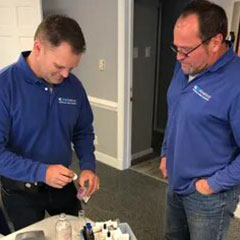
Advanced Water Systems – Kinetico Richmond provides residential water testing and treatment options for customers in Richmond and throughout its listed Central and Southern Virginia service area.
Call (877) 609-2837 or request a water evaluation and filtration estimate to discuss your water concerns and the types of treatment that may be appropriate.
Frequently Asked Questions
Can I get a water-filtration price without testing my water?
A preliminary discussion may be possible, but an accurate recommendation depends on the water concern, treatment scope, household demand, and installation conditions. Testing can help prevent purchasing equipment that does not address the actual problem.
Is an under-sink filter less expensive than whole-home filtration?
An under-sink system generally involves less equipment and treats a smaller amount of water. However, it will not solve problems affecting showers, laundry, fixtures, or every water-using appliance. The lower-scope system is useful only when it matches the homeowner’s goal.
Does a whole-home filtration system include a water softener?
Not automatically. Filtration and softening perform different functions. A proposal should explain whether a softener, filter, or combination is recommended and why each component is included.
Why do water-filtration estimates vary so much?
Estimates may include different equipment, treatment stages, capacities, installation work, warranties, or service. Compare the complete proposal rather than the total alone.
How much does it cost to maintain a home water filter?
Maintenance cost depends on the system. Potential expenses include cartridges, membranes, lamps, salt, treatment media, sanitization, and professional service. Ask for the model-specific replacement schedule before purchasing.
Is a professionally installed filter better than a retail system?
Not in every situation. A retail filter may be appropriate for a limited drinking-water concern. Professional evaluation becomes more important when the water has multiple problems, the entire home requires treatment, installation is complex, or a specific reduction claim must be verified.
External Sources
- U.S. Environmental Protection Agency: Point-of-use reverse-osmosis system definition, efficiency considerations, reject water, and maintenance requirements.
- NSF: Water-treatment standards, product certification, and model-specific contaminant-reduction claims.
- Kinetico: Drinking-water filtration categories and the role of water source and test results in system selection.
- Advanced Water Systems – Kinetico Richmond: Available treatment categories, water-testing services, service territory, and contact information.